Passing California Smog Tests
by Richard Atwell
(c) Copyright 2005-2011

Passing California Smog Testsby Richard Atwell |
|
|
1. Exemptions
2. The Smog Test
3. Emissions Test
9. The Test Report4. Fail vs. GP 5. Visual Test 6. Functional Test (EGR) 7. Function Test (Specs) 8. TSI vs. ASM 14. FI Tuning Obstacles 15. Why people unknowingly fail 16. Legal Modifications 17. Moving to CA 21. Test Checklist 22. Tips for Passing 23. Glossary 24. References |
Registering a VW bus is an increasing challenge especially with ever stricter smog limits that come into effect. When I first saw the passing limits imposed for 2004 I thought for sure every VW baywindow bus would either fail or have to be specially "tuned" to pass. You would then retune the engine afterwards for the sake of engine longevity. Fortunately this isn't the case. Passing the test isn't as hard as it seems: just because you own a vehicle from the 70s doesn't mean that it will pollute so much by comparison to a new model vehicle that you won't be able to register it. Tailpipe emissions are graded on a sliding scale that depend on model year and vehicle type. This is good news, if not for the air but for your wallet and your love for these old vehicles. If you live in California, you most likely live in a smog testing area but many other states implement or are in the process of implementing similar testing requirements that mimic if not duplicate CA exactly. Some people pass on the first attempt while others take several attempts. Some people give up and sell their bus in frustration. Overcoming the red tape is a great feeling of victory and relief but the process can often test your will. The biggest challenge for any owner is figuring out if a newly purchased bus is in a condition to pass. Because of all of the tampering by the mechanics and POs over the years the bus may have no chance in its current condition yet be close to passing given the appropriate attention. The key is to inform yourself about the process before you go for your test and that's the goal of this article. Some states like CA, forbid vehicle title transfers without a recent smog test but quite often the purchase takes place before the paperwork is complete. What to do when things go wrong is confusing for the VW owner so I've tried to compile all of the detail from my own experience and from others. Being prepared for your test is half the battle. Most of what I've written is universally applicable but the details are CA specific so if you live in another state be sure you understand the local rules and regulations. In August 2005, Oregon and Washington announced that they were going to adopt the California emission standards (the strictest in the country) in a few years. Even Texas is starting to smog vehicles in the metropolitan areas. Some states, like Arizona have exemptions but require you to register your vehicle as "collector" and limit the mileage you can drive. In the future, smog testing may be a problem for most VW owners no matter where they live. |
CARB is now requiring a "Low Pressure Fuel Evaporate Test" of the fuel tank. Any leaks due to cracked hoses in the system after pressurization is going to result in a fail. CARB has provided some info that explains how the test is done:
The ramifications of this test are that the fuel filler neck and hoses must allow the fuel tank to seal and the fuel evaporative lines that lead to the charcoal canister must also seal (no cracks).
FYI: the fuel line above the driver's side battery tray (hose in red) is notorious for cracking:

If you live and drive in CA, chances are that you've had a smog test. If you purchase a brand new vehicle you are exempt from testing for the first 6 years. It used to be 4 but was recently extended much to the displeasure of the people who profit from testing. I guess the legislators got tired of smog testing their own new model vehicles but they left in a profit loophole: if you buy a used vehicle it will only be exempt if it's 4 years old or younger.
Several years ago, your old vehicle was exempt from testing if it was built before 1968. This was an automotive era that predated factory installed emission equipment. In order to legally register such a vehicle you only needed to pay your registration renewal fee at the DMV despite being a so-called heavy polluter.
A few years back, the exemption was expanded to include all vehicles built before 1974. This cutoff meant:
In Jan 2003, SB42 was enacted by the CA legislature providing a rolling exemption. This meant that 1974 vehicles would be exempt from testing in 2003 and then 1975 vehicles in 2004 and so on. I personally was looking forward to January 2007 when my own bus was to become exempt but before we could pop the champagne corks, AB2683 was signed into law by then newly elected Governor Schwartzenegger that froze the exemption at 1975 model years. This means, that until the law changes all 1976 and later VWs are subject to smog testing (except for new vehicles previously mentioned).
This is government stupidity at its best because these late model baywindows are fuel injected models and far less polluting than the earlier models especially the dual carb buses built from 1972-74. Unfortunately, while the law is an ass, it is still the law.
Here's another sore point: although your 1976 bus may have been built between August and December 1975 it is considered a 1976 model by the smog testing system. In other words, it's model year, not manufacturing date that is considered for the cutoff.
Smog testing is a requirement every two years. The DMV mails out registration notices that remind you about smog testing every other annual re-registration mailing. The notice will tell you whether or not you must have your test performed at a test-only station or if you can go to any testing center. Test-only stations are just as they sound: they do not offer repair or tuning services in the event that you fail your test.
You get two attempts at passing. If you fail the first time, you retune/reapair the engine and you are allowed to retest for free at the same test station. Be sure to ask your test-only station if they will do this for you and report them if they don't. Beyond two fails you must take the vehicle to a special government approved repair shop (there are hundreds).
If you are near your registration deadline and have not passed your test or even taken it, you can still re-register your bus but they only give you a month of grace to complete your test. If you pass during the grace period you must re-register in person. If your leave your test to the last minute you won't receive your renewal stickers in time so it's best to go to the DMV early in the morning (when it opens is best). If you are an AAA member you can go to any of their field offices that offer DMV services, pay the fees and receive your stickers in person.
There are 3 components to the test:
None of the tests can begin until they locate and scan your BAR sticker. If you lack this sticker it means you have an out of state vehicle that has never been tested or it has been removed. You must make an appointment with the smog referee in this situation.
The air-gasoline combustion chemical equation is quite complicated but general air quality is effected the emissions of three by-products due to incomplete combustion: hydrocarbons (HC), carbon monoxide (CO) and various nitrous oxides (NOx). The gas sniffer used by the smog tester has the ability to detect all three emissions simultaneously.
The emissions test is where they insert a probe into the tailpipe to sniff for combustion byproducts and attach a coupler to any spark plug wire to measure engine rpm. With those two items attached they begin the test on the dyno.
The computer automates the testing and the smog tech simply uses a remote control to communicate with the computer from the driver's seat. The first stage revs the engine to 15 mph and they hold it there while the sniffer does its job. The tech has to shift the bus into 2nd gear to accomplish this. The computer then cues the tech to bring the engine to rest for the second run. The second time, the steps are repeated and the computer requests the speed be raised to 25mph for a few moments (3rd gear).
Each smog testing shop is supposed to calibrate their tester every 72 hours. Be sure to ask them about it. I don't know if the computer compensates for temperature variations but that would be something you could ask as well. They are also supposed to use a large cooling fan above 72F ambient temperature but since our VWs don't have a radiator this isn't necessary.
After the dyno testing, they perform a visual inspection. The visual inspection determines if any emission devices that were factory installed are missing. Although the list is long, only a subset applies to each model but if you are missing any item you will fail the test, unless the smog technician fails to notice that you require it when it's missing (don't gamble that this will happen for you). How can this happen? Because these vehicles were built before a lot of smog technicians were even born, many will find the engine compartment unfamiliar to them.
The functional inspection includes a check of the timing and idle speed. The idle speed has to be within the manufacturer's guidelines and the timing has to be within 3 degrees of the specification otherwise you will fail. This is the simplest of tune-ups to perform but some people drive to the testing center, cross their fingers and fail. They will also test the gas cap to see if it seals and check for the presence of any fuel pipe restrictors if applicable.
Be sure they know how to test the timing by clamping onto spark plug wire #1 or #3. If the do not, the timing mark will not appear and they may simply decide to fail you when the timing is indeed within spec.
A few years ago, the visual inspection was done first. At that time the testing was aborted any time you failed one of the stages in order. The benefit to the owner was that if you failed for something simple you wouldn't risk being tagged as a gross polluter (if you produced excessive emissions). The problem for the government was that they failed to collect any tailpipe emissions data in the process and so they have reversed the testing order.
So what exactly is the sniffer measuring?
HCs are essentially unburned fuel. When you hear about octane it's often a reference to the anti-knock index at the pump (87 etc) but it is also a reference to the chemical composition of fuel, part of which is made from C8H18 (eight carbon atoms and 18 hydrogen atoms; hence octane). HC is measured in parts per million (ppm) by the sniffer.
When fuel (HC) and air (O2 + N2) are combusted the ideal product would be energy and water vapor (H20). Because the combustion process is imperfect, CO is one of the byproducts produced. CO is measured as a percentage of the exhaust gas. It is a colorless odorless gas and if you breath it, it will combine with the hemoglobin in your blood and make you sick or kill you in larger doses. Running your engine in the garage is a great way to pass out and possibly die.
CO is also used as an indicator of fuel mixture ratio. An ideal percentage of excess CO would be zero. In practice the %CO measured is a few percentage points: a fuel ratio the VW engine can burn efficiently in all climates, temperatures and conditions. For example, 1-2% would be a relatively lean fuel ratio for a VW especially fuel injected models; 10% is very rich (so much so that you can smell the unburned fuel from the exhaust pipe and see it collect on the ground if it has been raining).
NOx is produced when combustion chamber temperatures are high. It was once viewed as the #1 environmental enemy and largely responsible for the smog in the LA basin. At that time emission reducing devices were geared towards reducing it at the expense of other emissions. That was 20 years ago and since then scientists have come to understand that all the emissions are destructive especially CO2 (a harmful greenhouse gas).
Unfortunately on a VW there is no simple way to minimize all three emissions at once like a modern car is able to do. Lower the HC and CO by leaning out the engine and you produce too much NOx and vice versa. Plus, the catalytic converter (which few air-cooled VW models are equipped with) can only do its job at the near perfect fuel ratio (theoretically ideal) which isn't the best ratio for long life of an air-cooled engine.
There are emissions limits for each of the three exhaust gases that are tested. Because the smog test is done at two speeds, this means that there are 6 ways to fail.
On top of that, there are a higher set of limits that are classified as Gross Polluter (GP). These limits are not as high as they used to be and if any of your exhaust readings exceeded the GP limit you were forced to have to smog your vehicle every year instead of every 2 years. I'm not sure if that's still the case anymore. Even so, you can be labeled GP on the first test and you will probably have to go to a repair center immediately.
One way to avoid this situation is to have a pre-test done at any smog station. This is a testing mode that does not record the results and transmit them to the DMV. The test is expensive (same price as a smog test) but worthwhile especially if you have never smogged before (or had the engine replaced recently) because you would be paying twice as much to smog every year if you get tagged as a GP.
Or you can get tested by your mechanic if he has an exhaust sniffer. Many use old Sun branded equipment and who knows when they last calibrated it?
The visual inspection is a check for the presence of the emissions control items installed by the factory. It's sometimes followed by a functional test of that item.
This is a complete list of the codes taken from the Mitchell Applications Guide used by the smog testing system (CARB). They appear on your smog sticker.
| Code | Item | Description |
|---|---|---|
| MFI | Fuel Injection | All Bosch L-Jetronic (VW AFC) components |
| PCV | Positive Crankcase Ventilation | Routes crankcase fumes to intake (to burn) |
| ACL | Thermostatic Air Cleaner | Intake air is heated by exhaust (via intake pipe) during warmup to reduce emissions |
| EVAP | Fuel Evaporative System | Connects fuel tank to intake for vapor recovery (to burn) |
| SPK | Spark Ignition Control | All advance, retard hardware and hoses |
| EGR | Exhaust Gas Recirculation System | Connects exhaust to intake to reduce NOx |
| OC | Oxidation Catalytic Converter | Converts HC, CO and O2 to CO2 and H20 |
| FR | Fill Pipe Restrictor | Prevents leaded fuel pump nozzle from being used to fill tank (ruins CAT) |
| O2S | Oxygen sensor | Exhaust mounted sensor that dynamically adjusts air fuel ratio |
| AP | Air Pump Injection System | Crank driven pump that injects air into exhaust port |
| AIS | Air Injection system | Similar to AP but without pump |
| TP | Throttle Positioner | Corrects for altitude variations |
| CEC | Computerized Engine Controls | Electronic ignition (no points, no condenser) |
| EVAP-VC | EVAP Vapor Canister | Charcoal canister in engine compartment |
| SPK-DDD | Spark Dual Diaphragm Distributor | DVDA distributor vs. SVDA or purely mechanical (009) |
| SPK-TCS | Transmission Controlled Spark | Vacuum advance cutoff transmission switch |
Big list isn't it? Those are all the separate smog devices found on the many VWs that are checked for. I'll cover each by year including the exempt models which maybe required in other states. Keep in mind that it is a violation of Federal law to tamper with the emissions devices in your car whether or not you are exempt from emissions testing. I'm not suggesting you break the law but in practice it seems everyone does anyway.
Personally I would keep any emissions devices from your engine rather than sell or dispose of them. Remote sensing of tailpipe emissions is a concept that is gaining popularity with governments and the possibility that you may have to restore the emissions devices on your exempt vehicle simply because a sensing vehicle near the highway onramp detected your exhaust and recorded your license plate is a growing concern.
Here are the details organized by model year. I've made note of the errors in the guide because Mitchell, the 3rd party company that provides the guide, does not have the facts we know to be true from Bentley and from visual evidence. What's not listed in the tests that you have extra equipment for is not a problem. Also, what's not clear is whether or not the requirements were US standards while VW added additional/substitute equipment (unlikely but possible). I suspect they've just recorded mistakes which have been perpetuated over the years.
Note: You will have EGR or O2S/CAT but not both. 79 Federal models are the same as 1978.
Note: I don't know why they think AIS was installed for 1978 models.
Note: only 75 thru 76 ½ vehicles up to and including VIN 226 2 077583 have the ACL system. Until revised guides from Mitchell are distributed to all testing centers and the computer system is updated, you may have to visit the smog ref to prove this point if your testing center decides to fail you for lacking it. Take along Mitchell's email reply to my complaint to help enlighten any smog techs that are confused by the computer data.
A DVDA distributor and retarded timing is also installed up to the above mentioned VIN but is not mentioned for some reason.
Note: this configuration also applies to 1974 CA Automatic models (VIN 214 2 132408 - 214 2 300000) which were first fitted with FI in USA.
Note: 74 automatic transmission models have SPK-TCS but the guide makes no mention of this. It also makes no mention of requiring dual carbs.
Note: the guide says some Type 2's have PCV but all of them do. It also makes no mention of requiring dual carbs. 1973 models also have the SPK-TCS system.
In addition to engine rpm and timing, the smog techs might test the EGR system. EGR works by introducing a small portion of the exhaust back through the intake. The goal is to reduce NOx emissions which are produced at high temperatures. Reducing the oxygen level == lowering the combustion temperature. When there is less O2 to combine with the N2 present in air == less NOx. It's effective but since the engine wasn't designed to run on exhaust there is a performance loss.
The valve is meant to be closed at idle and at wide open throttle (WOT) and open the rest of the time. The early EGR system from 73 thru 76 ½ was electo-vacuum operated and the later system purely mechanical via linkage to the throttle. The techs test the EGR by disconnecting the switch/linkage and watching the engine RPMs as they activate it manually.
The first step is to perform a visual inspection yourself before the test:
Quite often the muffler has been replaced and the system removed altogether. In this event you'll have to source the parts or cross you fingers the smog tech is lazy and doesn't notice. It may also no longer be part of the test. Unfortunately you cannot ask a smog tech what you require for your test without paying for a pre-test or taking the real test as they rely on the computer for instruction.

The filter's proximity to the engine and the fact it carries hot exhaust causes it rust and disintegrate. When this happens, a vacuum leak occurs. This pathway for so called false-air to travel will have the opposite effect of introducing more oxygen to the combustion process and make the engine run poorly and at a low vacuum level. False-air can also enter at any joint where there is a poor fit between engine mounted components.
The filters are still available although about $120-160 depending on the model year.
The filter to EGR pipe joint must be properly sealed and so must the valve to throttle body joint. Check the mating surface profile on the bench BEFORE you try to attach them. Gaskets are hard to find but the originals are long lasting (see link at end of article for gasket p/n). The EGR fit has never been great (especially w/ after market exhausts) so I find a double gasket at the filter sometimes helps.
The hardest system to test before the 74 models were exempted were the dual carbs version because it required the EGR valves be removed from the intake manifolds. For the smog test the tech only needed to attempt to close the throttle switch on the left carb. When he did, the rpms dropped indicating that the valve was open at idle. In cold weather he may have to bypass the temperature switch to perform the test. Since all dual carb 72-74 models are exempt in CA you don't have to worry about this setup anymore.
To test the early FI system the smog tech only needs to disconnect the green EGR electrical connector on the wiring harness. If the idle doesn't drop it means the connector is bad or there is a vacuum problem that is keeping the EGR valve open/closed. The throttle valve switch under the throttle body may not be closing which can be tested by shorting the switch closed. If the vacuum can is broken, you'll have to replace it with a spare.
The mechanical setup on the later FI models is harder to test because the linkage must be disconnected and activated by hand. If the linkage is missing then the valve will be closed at all times. If the internal spring is missing then the valve will be open at all times especially if the linkage is missing.
Adjusting the linkage is relatively easy: undo the 8mm locknuts and shorten the linkage until the idle drops. You will also notice that the vacuum level has dropped on your gauge. Lengthen the linkage until the vacuum level (as seen with a gauge) increases to maximum and then tighten the locknuts. You can follow Bentley's recommendation for the number of turns required to twist the linkage after the rpm drops. Bentley has different test instructions based on rpm but I find the vacuum gauge adjustment method to work best and requires no memorization or look-up.
There is a rubber valve inside the mechanical valve which can tear. Taking apart the valve is relatively straight forward but you will probably need to replace your broken unit with a viable spare from the junkyard.
Opinion: I find the EGR valve lessens the engine performance. This is because as you leave idle, a large amount of exhaust is dumped into the intake which causes a slight hesitation. Thereafter, the mixture is diluted which reduces engine performance. I find the bus runs much better without it (EGR was not installed on the 79 CA models highlighting its limited usefulness).

You can find EGR filters at the follow vendors:
021-131-617G -- fits 1974 CA Bus - 1975 up to Engine ED 000 639 and 1980 CA Vanagon
021-131-617F -- fits 75-78 Bus (available)
039-131-617 -- fits 79-83 Fed Bus & Vanagon (available)
039-131-617A -- fits above models but in CDN market (investigating why...)
071-131-617A -- fits 81-82 CA Vanagon (available)
Note: all these part numbers reflect the dizzying array of exhaust configurations the factory used. If you have a 75-78 bus and you've switched to the 72-74/79 style exhaust the stock EGR filter will not fit because the pipe is too short. If you have a CA exhaust setup with the special driver's side heat exchanger you'll need a CA model EGR filter.
The photo to the right shows how the filters vary greatly in configuration and are not easily adapted.
Having the correct timing is not only necessary for the functional test but it may effect your emissions. You can be up to 3 degrees off spec but that's a world of adjustment to the VW engine. When VW says it runs best at 7.5 BTDC for example, they mean it: even ½ a degree is noticeable during acceleration.
A tach/dwell meter and stroboscopic timing light are all you need to make sure you are in spec. This table summarizes the factory timing specs:
| Model Year | Timing | Idle speed (MT) | Idle speed (AT) | %CO | Comments |
|---|---|---|---|---|---|
| 1979 CA | 5 ATDC | 800-950 rpm | 850-1000 rpm | 0.2 - 1.2 | See idle stabilizer notes in Bentley |
| 1979 Federal | 7.5 BTDC | 850-950 rpm | 900-1000 rpm | 0.5 - 1.5 | |
| 1978 | 7.5 BTDC | 850-950 rpm | 900-1000 rpm | 0.5 - 1.5 | |
| 1977 | 7.5 BTDC | 850-950 rpm | 900-1000 rpm | 0.9 - 1.1 | |
| 1976 | 7.5 BTDC | 850-950 rpm | 900-1000 rpm | 0.9 - 1.1 | from VIN 226 2 077584 |
| 1976 | 5 ATDC | 900-1000 rpm | 0.2 - 2.0 | up to VIN 226 2 077583 | |
| 1975 | 5 ATDC | 900-1000 rpm | 0.2 - 2.0 | Same as 79 CA Auto (FI) | |
| 1974 | 10 ATDC | 800-950 rpm | n/a | 0.5 - 1.5 | Manual |
| 1974 | 5 ATDC | b/a | 800-950 rpm | 0.5 - 1.5 | Automatic |
| 1973 | 10 ATDC | 800-950 rpm | n/a | 1.0 - 3.0 | Manual (to Dec 72) 0.5 - 1.5 after |
| 1973 | 5 ATDC | n/a | 800-950 rpm | 1.0 - 3.0 | Automatic (to Dec 72) 0.5 - 1.5 after |
| 1972 | 5 ATDC | 800-950 rpm | 2.0 - 4.0 | ||
| 1971 | 5 ATDC | 800-950 rpm | 2.0 - 4.0 | ||
| 1970 | 0 ATDC | 800-950 rpm | 2.0 - 4.0 | Vacuum hose disconnected | |
| 1969 | 0 ATDC | 800-950 rpm | 2.0 - 4.0 | Vacuum hose disconnected | |
| 1968 | 0 ATDC | 800-950 rpm | 2.0 - 4.0 | Vacuum hose disconnected | |
MT - manual transmission
AT - automatic transmission
A couple of years ago, exhaust emissions were tested in neutral at two engine speeds:
This was called the Two Speed Idle (TSI) test.
Smog tests are now done on the dynomometer (aka the rolling road) although some test areas may not have implemented this system because the dyno equipment is expensive. The dyno test is called Acceleration Simulation Mode (ASM) by CARB. The exhaust is sniffed at 15mph in 2nd gear and 25mph in 3rd gear to gain a more realistic sampling of engine emissions.
Just judging by the numbers, the old TSI test was lenient by comparison to the current ASM standard but the ASM test is supposed to be easier to pass than the old test because the engine leans out under load and light throttle. Keep in mind that the smog limits are strict enough that you are likely to fail if you go in the test unprepared because of the lack of modern engine management (computer controlled ignition, pre and post CAT oxygen sensors etc).
These are the Pass/Fail/GP limits for the 75-78 bus category weighing 3500 lbs (a typical CA smog test subject vehicle ;-).
| Pass/Fail | Gross Polluter | ||||||
|---|---|---|---|---|---|---|---|
| CO | HC | CO | HC | ||||
| Idle | 2500 | Idle | 2500 | Idle | 2500 | Idle | 2500 |
| 2.5% | 3.0% | 250ppm | 200ppm | 5.0% | 5.5% | 500rpm | 550ppm |
Min CO + CO2 is 7%. Idle rpm max: 1100. Notice there was no NOx test performed.
| ASM Pass/Fail | |||||
|---|---|---|---|---|---|
| CO | HC | NO | |||
| 15mph | 25mph | 15mph | 25mph | 15mph | 25mph |
| 1.66% | 1.46% | 204ppm | 169ppm | 1534ppm | 1394ppm |
| ASM Gross Polluter | |||||
|---|---|---|---|---|---|
| CO | HC | NO | |||
| 15mph | 25mph | 15mph | 25mph | 15mph | 25mph |
| 3.16% | 2.96% | 394ppm | 344ppm | 2791ppm | 2591ppm |
The results from my own report are a good guide as to what emissions you can achieve (see next section).
When they roll you onto to the dyno, the vehicle is weighed and that factors into the ASM standards that are set by the BAR scientists.
1) To figure out the EXACT emission limits, you need to calculate your vehicle weight. Since the dyno scale may not be the same as yours, your calculated limits will be estimates. Where can you weigh your vehicle? Find a recycling yard that charges by the pound and drive onto their scale. You can often read the display and learn the weight as you are talking to the scale technician in his booth before you have to turn around. Usually they are friendly enough to help you out. Some highways have weigh stations for commercial trucks.
2) Look up the current ASM emissions standard for your model year. Then look under Minivan. (2003 version as PDF)
The ASM cut points table shows the formula as A+B/VTW. A and B are both shown in the table and VTW (vehicle test weight) depends on what you have in the bus at the time you roll onto the dyno.
I believe the formula on the document is incorrect so I filed a misdemeanor complaint against BAR under the Business & Professions Code (sounds crazy but that's how CA works I'm sad to say).
In my opinion the formula should be A + (A+B)/VTW which will calculate the test limits. For example, my 78 bus falls into ESC 10 by weight and vehicle type.
Let's figure out the %CO limit:
CO limit A = 1.08 (15 mph), 0.88 (25 mph)

CO limit B = 2025.00 (15 mph and 25 mph)
3) Punching those numbers along with the 3500 lbs vehicle test weight into the formula:
1.08 + (1.08 + 2025)/3500 = 1.66 %CO

0.88 + (0.88 + 2025)/3500 = 1.46 %CO
Good: exactly the same as my test report below. Now look at the stricter limits for the 79-83 vehicles:
0.88 + (0.88 + 2025)/3500 = 1.26 %CO

0.68 + (0.68 + 2025)/3500 = 1.46 %CO
D'Oh! Even lower limits! What if your 76-78 bus vehicle weighs 4000 lbs?
1.08 + (1.08 + 2025)/4000 = 1.58 %CO

0.88 + (0.88 + 2025)/4000 = 1.39 %CO
I have to conclude from the formula that the heavier your vehicle is the lower the limit and the harder it will be for you to pass. Try to go to the test with the bus as empty as possible). A full gas tank and full water tank weighs about 150 lbs. What else do you have inside in your bus (spare tire, stored gear, bars of gold)?

The top of the test report will identify your vehicle type. Be sure that the following item are correct because they will affect the test:
If they are not you should contest the results if they are not in your favor. Unfortunately you don't get to see this information until the test report has been printed out. If your smog tech is nice he will do his best to enter the correct information when he sets up for the test.
For example, the smog ref initially entered 5,999 lbs as the GVWR weight of my bus into the smog system. Every test this comes up as the default but the good techs re-enter the value read from the VIN sticker in the doorjam (2250 kg which you often have to help them convert to 4950 lbs).
The top-middle boxed portion of the test report will indicate whether or not you passed, failed or were a gross polluter. It also will show your certificate number if you passed.
The middle portion is for the visual inspection and indicates which tests were applicable and which you pass/failed.
The bottom of each report details the emission results. Here you get to see the exact measurements that were made. The exhaust analyzer samples five different gasses simultaneously and you have be under the MAX limit for each of three gasses (HC, CO and NO). The C02 and O2 levels are collected from each vehicle for statistics.
For the TSI test you can limit yourself to setting the air fuel ratio (AFR) at idle. If you have good combustion the CO numbers will not creep up after they release the throttle. If your engine isn't burning fuel correctly (weak spark, low compression, etc) then you'll have high HC numbers.
I was naturally unprepared for my first test thinking the smog referee would only be helping me assess my vehicle. Instead he recorded the test results and I had left the checking of the AFR to the mechanic 5-12 years ago.
Here were my 2002 results:
| %CO2 | %O2 | HC (PPM) | CO (%) | |||||||
|---|---|---|---|---|---|---|---|---|---|---|
| Test | RPM | MEAS | MEAS | MAX | AVE | MEAS | MAX | AVE | MEAS | Results |
| idle | 876 | 8.1 | 7.8 | 250 | 73 | 186 | 2.50 | 0.50 | 2.49 | PASS |
| high rpm | 2499 | 13.9 | 0.8 | 200 | 67 | 74 | 3.00 | 0.90 | 0.45 | PASS |
The first test run actually recorded a fail at idle as they hold the engine above idle before letting it drop back down to idle and then take the sampling. That reading was 3.5% CO at idle.
I convinced them to adjust the AFR and re-test rather than have me come back because it was a long drive from my house to the referee center. I whipped out the Bentley and with a screwdriver the smog ref turned the screw out 360 degrees and we crossed our fingers. On the second test, the engine actually creeped up to 2.51% momentarily but he ended the test when it dropped to 2.49% and that's what was recorded in the system. What I didn't know at the time was that the first test was counted and recorded in the computer. A second fail would have required me to go to a mechanic for inspection and repair. I was at the smog referee because my vehicle came from out of state.
The lesson here is to have your idle AFR measured before you go for your test (there is also a limit to how much the screw will alter the idle AFR). You might as well get this done at your mechanic because a smog test station will cost about the same as an hour of labor and they won't perform any adjustments. I was lucky because the smog ref had less interest in my vehicle failing a second time (to make money from the repair). A regular smog tech especially one running a repair shop wouldn't have been so nice.
If I had lowered my idle %CO to spec prior to the test I would have easily passed but how would I have measured it? You need a wide-band oxygen tester...
Before a smog test, I try to set my idle exhaust emissions to 0.7% CO (the factory setting is 0.5% to 1.5% CO for my model year and transmission type). This produces the following measurements before any other adjustments:
| RPM range | %CO | AFR |
|---|---|---|
| idle | 0.7 | 14.2:1 |
| light throttle | 0.1 | 14.7:1 |
| half throttle | 2.5 | 13.6:1 |
| WOT | 5.0 | 12.6:1 |
There are a couple of traditional ways to get you bus in tune but consider the drawbacks:
This is where a portable wide-band O2 tester is far more useful. Armed with one of these, a location to mount the sensor and a tachometer you are on your way to independence as far as smog testing is concerned (one of the last bastions of engine maintenance whose price have come down to the hobbyist level thanks to low cost technology from Bosch: the LSU-4 O2 sensor).
You will also need a chart to convert readings because most testers only display Lambda and AFR while the smog test registers %CO. Download the Conversion Chart and print it out.


A wide-band tester like the Innovate LM-2 (which replaces the venerable LM-1) is about $350 but you'll recover the money over several tests by not having to pay for testing through other means and you'll have the personal satisfaction of "beating the system". I even use mine to help friends and other bus owners who've become trapped between repair shops and the smog system.
Innovate is by far the best product available as rated for cost/accuracy. They do make a less expensive LC-1 cable ($199) which connects directly to your laptop but for ease of use, the LM-1 is what I prefer for its built-in display and you can still connect a laptop later if you want to graph RPM/load vs. AFR.
You'll need to get someone (perhaps a muffler shop) to weld an oxygen sensor bung onto your exhaust unless you have a CAT from the factory 75-79 setup with a test port. One such unit is the EMICO replacement CAT which the FI beetle also uses (hence the 043 part number).
Note: this CAT does not come with a plug. See a muffler shop for a plug to cover the hole or use an old worn out O2 sensor when not in use.
Also note that this CAT is for federals models only (see Why people unknowingly fail).
Before adjusting the AFR, you must have performed all the other tune-up adjustments because CO is always adjusted last.
Pre-checklist:
The idle mixture will affect the AFR at all settings but it is most influential at idle. The idle mixture screw is connected to a conduit that in my estimation allows 5% of the air to bypass the air sensor flap when it's fully open but represents a large portion of the air bypassing the flap at idle (including the warm-up fast idle rpm). If you are only 1-2 AFR units out of spec you will most likely have luck resetting the AFR using only this screw unless the screw is already at the extremes.
When you cannot get the AFR into spec at all rpms after adjusting the idle mixture screw, you will need to open up the AFM but only then. If you are failing badly, adjusting the mixture won't perform miracles. For example, if you have high HC or NOx levels you need to cure those first (see Why people unknowingly fail). The adjustment I'm going to detail mainly affects the CO level which is the biggest obstacle to passing for those with an otherwise well running bus.
While the general throttle readings I first mentioned in the previous section are a guide for you to achieve my results and provide a simplistic view of Bosch L-Jetronic fuel mapping, what matters most is recreating the test conditions ("simulating the simulation"). In other words, going for a drive with the LM-1 display visible by you or preferably by a friend, recording the results and performing adjustments at the side of the road (please be safe and choose quiet roads for your testing):
Start the engine, let it warm up and then adjust the idle mixture screw so that it is roughly in the middle of its range of travel for future refinement.
You want to record the AFR reading from the LM-1 at the same speeds they use in the smog test + idle. In order to do this you will need a section of road that is flat and long enough to let you maintain those speeds and quiet enough so that you are not going to be holding up traffic.
Those will be your baseline readings; keep organized using a piece of paper and record your initial results before making any adjustments. Using the conversion chart you will now tune the AFR by trial and error. Because the LM-1 displays AFR, I would pick a target %CO reading, convert it and then continually compare against that number (say 14.5:1) rather than do the reverse conversion.
With your first "pass" complete, pop the cover and adjust the AFR slightly by leaning it out a little (see FI Tuning Obstacles for the exact technique). When you do this you are making an adjustment relative to the idle reading but it will have an effect throughout the driving range because moving the wiper shifts the AFR mapping set by the factory. Try to adjust it by 0.5 AFR unit at a time. Then go for a drive and compare the readings you get at the two test speeds to your last result. Avoid the temptation of adjust the idle mixture screw.
Keep adjusting the wiper until you get the %CO below 1.0 at both speeds and you should have no trouble passing. When you are done the engine should have no trouble idling or driving at speed. If the reading is too rich or too lean at idle the engine will stumble noticeably. If you lean out the engine beyond 15.1:1 to help ensure a pass, you may fail the NOx test so stick to the ranges I've specified.
The wiper adjustment is hyper-sensitive. You only need to tap the backside where the screw is located lightly with a screwdriver before the reading with change and then you tighten down the screw before taking another test drive. It will take a few tries before you get the technique down to the point where your adjustment is what you want after you tighten the screw, not before. The trick is only to loosen the screw just enough to let the wiper move but not enough to let the moment be so free that the wiper moves as you re-tighten the screw.
With my engine, I measure about 14.5:1 in those two gears at 2000 rpm. If your measurements are accurate (thanks to LM-1's accuracy) you should have no trouble passing if you can keep your reading above 14.0:1.
A cold engine always runs too rich to compensate otherwise the engine would stall. Before taking your test, make sure you run the engine at 50mph for 20 minutes to ensure that it's warmed up for the test (heat soak will keep it warm while you are waiting in line for the test for any reasonable length of time).
Here are my 2004 results:
| %CO2 | %O2 | HC (PPM) | CO (%) | NO (PPM) | |||||||||
|---|---|---|---|---|---|---|---|---|---|---|---|---|---|
| Test | RPM | MEAS | MEAS | MAX | AVE | MEAS | MAX | AVE | MEAS | MAX | AVE | MEAS | Results |
| 15 mph | 1990 | 13.9 | 1.2 | 204 | 49 | 48 | 1.66 | 0.30 | 0.19 | 1534 | 592 | 652 | PASS |
| 25 mph | 2018 | 13.8 | 1.5 | 169 | 40 | 31 | 1.46 | 0.27 | 0.11 | 1394 | 500 | 563 | PASS |
Here are my 2006 results (not much change except my NOx has gone up by 30%):
| %CO2 | %O2 | HC (PPM) | CO (%) | NO (PPM) | |||||||||
|---|---|---|---|---|---|---|---|---|---|---|---|---|---|
| Test | RPM | MEAS | MEAS | MAX | AVE | MEAS | MAX | AVE | MEAS | MAX | AVE | MEAS | Results |
| 15 mph | 2068 | 14.2 | 1.4 | 204 | 49 | 50 | 1.66 | 0.30 | 0.16 | 1534 | 592 | 849 | PASS |
| 25 mph | 2072 | 14.1 | 1.6 | 169 | 40 | 35 | 1.46 | 0.27 | 0.13 | 1394 | 500 | 727 | PASS |
The LM-1 was right on the mark both times! Notice my NOx readings are higher? I'm not certain how much of this increase is related to the leaner setting from 2006.
Functional items they did not test according to the report:
It now seems that BAR knows that these items are not specific to my model. Good news and somewhat gratifying having sent in my feedback to Mitchell 2 years ago. I no longer have to worry about my smog sticker being incorrect.
When you pass you are issued a certificate number which the DMV uses during the registration process. The results are sent electronically from each smog station to the DMV to help eliminate fraud.
I recently came across some test results from the government when they computed the EPA mileage estimate in 2/78. Results are from CITY driving tests following by HWY results in parenthesis and results are given in g/mi (grams per mile).
Source: http://www.epa.gov/otaq/tclrep.htm

Federal model / 405-Z-7283:

HC: 1.21 (0.38)

CO: 11.50 (2.80)

CO2: 489 (351)

NOx: 2.56 (2.97)


CA model / 405-Z-7282:

HC: 0.63 (0.08)

CO: 12.40 (2.40)

CO2: 473 (351)

NOx: 0.93 (1.48)
To give you an idea of how these numbers compare, the current Tier II Bin 5 emissions standard limits CO to 4.3 g/mi and NOx to 0.07 g/mi. As you can see, NOx reduction has come a long way since 1978.
I don't have a means to convert grams/mile to % and ppm because I lack knowledge of the test procedures but I thought it was worth noting for posterity before the information disappears online. What's most interesting is that it demonstrates what a dramatic difference the catalytic converter makes to the emission levels.
The lower HC and NOx levels are solely due to the presence of the CAT and why EGR systems have largely disappeared from the engine compartments of more modern vehicles with their 3-way catalytic converters.
In the 60's high levels of HC and CO emissions were blamed for the brown haze that engulfed the LA basin. In an effort to reduce them, engines were leaned out but an equally damaging effect resulted: high levels of NOx emissions which created a grayish haze instead. This is the balancing act of incomplete combustion according to the air fuel combustion chemical equation as shown in the graphs as the dotted lines:
Before 1975 when CATs were introduced, the only way to reduce NOx was to keep the fuel mixture rich. With the CAT installed, both HC and NOx are lowered which allows you to run near perfect AFR and reduce CO levels as well. Brilliant.
If you can install a CAT on your engine, I would recommend doing so. It is good for the environment and will help you pass your smog tests by reducing your HC and NOx emissions by 50-80%. As I said earlier, the government doesn't want you to modify your engine even if it means producing lower emissions!. See the Legal Modifications section for more info.
Getting the exhaust within spec can sometimes be a chore if the engine is worn out or if parts have been tampered with. Here's a check-list to help you get into tune.
Electrical - You need good FI grounds (under the plenum) and 12V from the battery. This along with a check of the vacuum hoses are the usually culprits as the vehicle ages.
Fuel Pump - a weak fuel pump may cause the engine to stumble or lean out the exhaust too much. You can test the fuel pressure (28-35 psi) and the amperage (2.5-3.5A).
Fuel Pressure Regulator - a broken regulator often causes an over rich condition because the fuel pressure is not reduced as the vacuum level of the engine increases as it normally should. It is the PR that reduced the fuel line pressure from 35-28psi as the volume of air passing the AFM increases. The pressure regulator (PR) should maintain the fuel rail pressure for a long time. If it's leaking then it can be harder to start a warm engine.
Injectors - if the spray pattern of your injectors are poor, you will have to recondition them. The resulting poor atomization of fuel can result in higher HC emissions at the tailpipe. If you have a bad injector there will be a excess of air pumped through the exhaust and the engine will be laboring on 3 cylinders. The injectors are rated at 185cc/min and they need to be benchmarked to make sure they are working as the ECU expects them to but they only do that if the fuel pump is working properly.
Cold Start Valve - When the engine starts the cold start valve (CSV) gives the engine a burst of fuel to help it get going. The thermo time switch (TTS) prevents the CSV from firing if the engine has already warmed up. If the CSV is not working the engine can require more cranking to start. If it's leaking then the engine can be running too rich.
Aux Air Regulator - At startup, the aux air regulator (AAR) allows some air to bypass the throttle to speed up the engine to overcome the resistance of the cold rotating parts until they both time-out by design. If the AAR doesn't close then idle simply gets adjusted to compensate but the engine tends to run too fast after it's warmed up.
Temp Sensor II - this sensor influences the fuel ratio especially during startup. When the circuit is open the mixture becomes so rich the engine dies. When the resistance is too high, the mixture will be richer than normal. When the circuit is shorted, the engine can have a hard time warming up because the AFR is too lean and will cause the engine to run too lean after it has warmed up. Adjusting the AFM could compensate for a bad TS2 when it is warm but it cannot help it warmup (the TS2 exists to report the engine temperature to the ECU). See my TS2 article for the test values.
AFM - Normally the idle AFR is adjusted by turning the bypass screw on the AFM (later production Bosch replacement units require an allen key instead of a flat baded screwdriver).
If you have excessive emissions by FI standards you may have to adjust the AFM by opening it up. This is because the idle adjustment screw has a limited effect on the AFR at speed. Unless you are taking the TSI smog test, you won't get much out of adjusting that screw if you are grossly out of spec.
That said, you must attempt to get the idle mixture set correctly before you perform any adjustment on the wiper. About 5% of the max airflow bypasses the air sensor flap inside the AFM. However at idle, a significant amount of the airflow goes through this channel as a percentage of the overall airflow. The ECU decides what to set to AFR to based on a baseline setting + the air passing the air sensor flap + the intake air temperature (IAT or TS1) + the head temperature sensor (TS2). It's important not to single out any one component: they are all important ECU inputs for the determining the appropriate AFR. Some models have extra switches on the throttle that contribute as ECU inputs.
What's important to understand is that the wiper inside the AFM greatly affects the AFR while driving but at idle and during warm-up (1050 RPM -> 900 RPM) the idle mixture screw also has a great affect on the AFR because it adjusts the airflow to the engine against the ECU baseline. The screw doesn't allow for much adjustment overall but it can greatly adjust the AFR for the amount of air that it allows to bypass the air sensor flap. Of course the air sensor flap moves based on the vacuum level of the engine.
Before making any adjustments, record the current state of the engine and break your measurements into 3 groupings (starting, warm-up, warm idle). Then make your adjustments and test again. Startup testing will require letting the engine cool, sometimes overnight to correct major running problems due to PO fiddling. Keep in mind that most starting problems are ignition/timing/fuel related. Everyone like the blame the FI because there are so many components but it has proven very reliable over time (know of any carbs that have stayed in tune for 25 years?).
Warm-up problems depend on the state of the vacuum hoses and the various sensors I've already mentioned. Once the engine is idling, you can then decide what to set the AFR to using the idle mixture adjustment screw and then the AFR can be fine tuned for driving using the wiper.
Turning the idle mixture screw by a full turn can adjust the AFR by 0.5 which may get you into spec but its more important to have the idle mixture set appropriately so that there is a smooth transition from idle to part-throttle. If you can blip the throttle from the engine compartment and there is no hesitation (EGR disabled), the setting is appropriate although the overall AFR may not be ideal or let you pass.
Your AFM whether a factory original, new or NOS came with a thin clear silicone bead sealing the top. Bosch New is different from the other two simply by the lack of a VW part number on the top. If it's been remanufactured by Bosch or one of the major rebuilders, then it may have a sticker on top to indicate or an X added to the part number. If the PO has broken the factory seal to adjust it there will probably have a nasty silicone mess like the unit pictured below.
Before opening up the AFM to adjust the wiper, test it for faults: the first thing to test are the 6/7 pins according to Bentley. If the results are way out of spec you can crack open the top to see if you can determine if there is a an obvious wiring fault. In some cases you will need a new unit.
The next item to test is the IAT (intake air temperature sensor) via pins 6/27. This is only if you have a 7-pin AFM where Bosch added this sensor to fine-tune the AFR. The reading needs to be a max of 2800 ohms at 20ºC which will often require you to bring the AFM into the house for the test.
Often the resistor track inside has so badly worn that you can't get a smooth signal. Sometimes the track has worn down to the ceramic but only in the position where the wiper usually sits at idle.
Another wear spot is at the underside of the copper arm the connects to the wiper. A dead spot from rotational wear can exist in certain wiper positions and Bosch knew this was a design flaw because later AFMs added a ground wire from the copper arm directly to the wipers.
When all of the above checks out, you'll just need to perform an internal adjustment to correct the AFR. There are two adjustments possible:
Minor: rotating the wiper arm will shift the AFR up and down by as little as 0.2 %CO increments. Moving the arm CW decreases the fuel for a given airflow (lean).

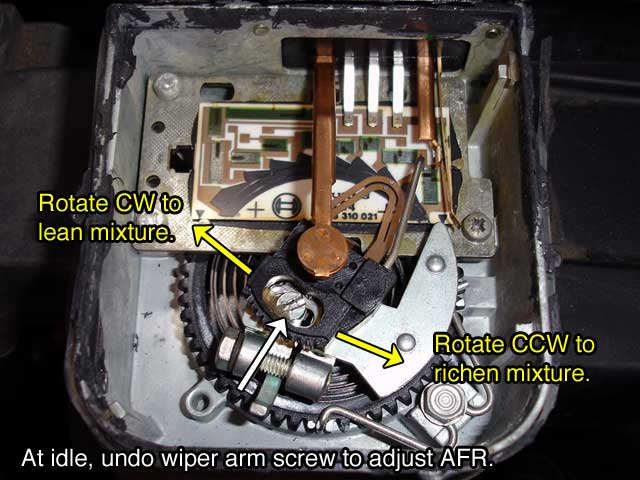
Adjusting the wiper screw with the engine turned off is counter productive because the wiper arm position is very sensitive as far as the ECU is concerned. You need to monitor the exhaust with a tester during adjustment to be able to watch the changes to your idle AFR adjustment because as you tighten the screw it will alter the adjustment. When you are dialed in, put a drop of purple Loctite on the screw.
Be careful not contaminate the AFM! A spec of dirt can get trapped between the wiper arm and the resistor track and stall your engine until it is removed. This may not happen in the city but head to the beach or dunes and you can be stranded wondering why the engine won't run so seal the AFM properly (the engine compartment is always dirty!).
If you do decide to adjust the gear, mark it's position with a couple of white dots from a marker so you can return it back to its original position if needed.
High HC. Excessive hydrocarbons can be caused by a clogged catalytic converter or it can be as simple as a larger than normal amount of ignition misses. It's normal for the engine to miss once in a while at idle but if it happens too much then unburned fuel will exit the tailpipe. Low compression and valve timing can cause the engine to miss and it can also be induced to miss when the fuel injectors are clogged or vacuum leaks (false air) are introduced. Holding a piece of white paper a few inches behind the exhaust when the engine is warm can indicate the presences of excess fuel.
Fuel injection missing. Unfortunately, too many POs and mechanics have removed the simple L-Jet system from buses simply because they couldn't figure out basic issues like a clogged fuel tank or a poor electrical connection. Diagnosis is easy when you know how, unfortunately there are too many untrained mechanics out there who get paid to fix cars who don't know how. This is a pity especially since FI makes it easier to pass smog. This modification (replacing FI with carbs) falls under the tampering category which makes it harder to retest because it may require you to go to a certified repair station or smog referee for your retest. The smog referee is an adjudicator with his own testing station that can determine whether or not your vehicle should pass when it has been modified. A common modification is an engine swap to an engine from a newer model year.
EGR missing. Quite often when the muffler has rusted and been replaced with a unit that has no provision for the EGR system anymore the rest of the system is blocked off or removed. Returning the exhaust to the original setup isn't always possible or affordable so finding an aftermarket muffler with the EGR port is necessary.
CAT missing. In your doorjam and on the engine compartment lid are informational stickers that will indicate whether or not your bus is CATALYST or NON-CATALYST. This indicates whether you are supposed to have a catalytic converter or not. Quite often it has been removed by the PO or his mechanic and there is no way around passing unless you buy a new one and fit it. If you have an aftermarket exhaust you may be unable to mount one easily. Note that the 79 CA model has a one year only CA exhaust setup that could drive you nuts trying to locate replacement parts.
CAT not CARB compliant. In 2010, California tightened up their standards by issuing new rules regarding approved manufacturers of replacement parts. CATs are available in two models: CARB approved (even for Federal models registered in California) and Non-CARB approved (49 states). Be sure when buying a converter that it is a CARB approved converter or you will not pass the visual portion of the smog test. The 49 state model cannot be purchased in California or shipped there for these reasons (not that it would help you pass the visual test). At present, there is only one company manufacturing CARB approved converters and that is DEC and the correct part number is VW83404. Is it also 3-5x the cost of the other one (Thanks to the ever-knowledgable Jim Thompson for this info).
Fill pipe restrictor missing. This is a CA issue which is frustrating. The restrictor was placed on CA vehicles to prevent a leaded fuel pump hose from being inserted into the fuel tank. Even though CA banned leaded fuel years ago and the nozzles have been replaced, this is a holdover from the days when it was available and it's to prevent leaded fuel from ruining your CAT. The problem that occurs is that the restrictor is rubber and part of the fuel filler neck and it cracks from age. The smog techs see the cracks and fail you. Crazy isn't it? The CA fuel filler is often called the bird beak because of its shape when viewed from the back side. There are three solutions I know of:
Check engine light. This is a term used on modern cars but it applies to certain models (mainly 75-79 CA) that have an EGR/OXS or EGR/CAT lamps on the instrument panel under the fuel gauge. These lights come on at 15k mile intervals as a reminder to check those systems. This was normally done at the dealership as part of required maintenance but probably hasn't been done in years. CATs clog, O2S sensors fail and EGR filters clog (they mainly rust out because they are so close to the exhaust). There is a slim chance that one of these lights will come on during the test because the rear wheels are now racking up some partial mileage compared under the ASM test vs. the old TSI test that was done in neutral with the wheels fixed. There is a reset button on the speedometer box that is behind the driver's side kick panel. Be sure to reset the lights before you have your bus tested.
Engine swaps are legal as long as the smog referee approves. Typically this is done to replace the original engine with a much bigger one (for example, putting a Subaru 6-cyl into a water cooled Vanagon). Referee approval is not required as a matter of simple crankcase replacement or repairs.
Because all FI models are virtually identical it's not worth mentioning to the smog tech (in fact never do this) if you happen to have a 78 engine code in a 76 bus or vice versa. Engine replacement is common with VWs so just cross your fingers they don't care about the engine code. What does matter is that you swap over the model year correct intake and exhaust systems to the new engine.
If this becomes an issue while testing, the smog referee will have to determine if your swap is acceptable. This means he will be looking for all of the specified devices and any indicators on the dash. If he deems the swap acceptable and you pass the emissions test, you will "youth" the vehicle. For example, a 1976 bus with a 1978 engine will be smogged as 1978 ever after. This would only matter if the exemption cutoff was extended to include 1977 models.
What can never be approved by the smog referee is a swap to an earlier model engine. Even though all single and dual carb baywindows are exempt you cannot replace a 76-79 engine with an earlier one.
Other than an approved engine swap you cannot tamper with any part of the engine. It must be in factory configuration but many of the ignition system upgrades have a CARB exemption in the form of executive orders (CARB EO). One such item is the Pertronix Ignitor. Since it installs under the distributor cap no one even knows it's there until they look but it's good to know about this legality anyway.
AFAIK, any electronic ignition can be legally fitted to any VW model.
If you are moving from another state to California or buying an out of state vehicle you will have to visit the smog referee for your initial test. You call the Bureau of Automotive Repair's (BAR) 1-800 number and make an appointment. The reason you cannot go to a testing station is because every CA vehicle has a bar code sticker that the smog tech has to scan into the computer system. When you pass, the smog referee will print out one of these stickers and affix it to your vehicle. Ask them to affix it beside the timing sticker on the back of the engine lid. If they complain that it can't be attached to a removable part, convince them (like I did) that the lid cannot be removed (the bolts will likely be hidden from view). They normally affix the sticker in the doorjams (or engine compartment when the engine is up front).
You are required to register you car within 20 days of establishing employment or residency in CA (whichever comes first). This is a drag because often you cannot make an appointment with the smog referee within that time. I've never heard of someone being fined for this but it's possible because the government regulations are poorly written. If you think that's inconvenient, they only give you 10 days to apply for a driver's license!
You also have to get the DMV to inspect your vehicle. They will look for the factory stickers and record the VIN. If you've repainted your bus and removed any of these you may have trouble.
As a matter of interest, you are not allowed to register a out of state vehicle in CA with less than 7,500 miles on the odometer. This is to force Californians to purchase CA models from Calif dealers which the dealerships take advantage of by marking up the price. The only impact this has on our buses is that the odometer has only five digits so if your mileage is 100,000 - 107,500 miles or any increment of 100k miles afterwards you may have to convince the ignorant DMV employee that your odometer has rolled over by providing prior registration documentation. If your odo is in KM, I've found they may not even account for that.
Although you can renew your registration at AAA if you are a member, all the initial work must be done through the DMV which means waiting in long lines. You can make an appointment with the DMV buy they often give you a date that is weeks or months in the future. Only the vehicle inspection can be done without getting in line first.
If you are buying a vehicle from or selling to a CA resident it is supposed to have a recent smog certificate. Specifically, the last smog test must have been done within the last 90 days. If the smog report was submitted to the DMV within the last 90 days of the vehicle being re-registered by the previous owner you do not need to have another test done. If the vehicle has yet to be be re-registered by the PO, the certificate is only good for 90 days. If you buy a vehicle from a family member you are exempt from the 90 day requirement.
Contrary to popular belief (and what is written at the DMV website), you apparently CAN buy and register a used vehicle without a smog certificate. The DMV will issue you temporary documentation in order to get the testing completed. Once you pass (within the time limit) they will issue you with permanent title and registration.
Previously, low income persons were eligible for government assistance to help them repair their vehicles to pass smog. As of 2004, the Consumer Assistance Program (CAP) has been expanded to include anyone whose vehicles fail smog at test-only stations. This means the government will pay up to $500 to repair your vehicle to pass smog after you've paid $100 towards the cost yourself. You can even count the cost of your failed smog test. The reimbursement includes the cost of parts and labor but you will only get reimbursed if you file for assistance and are approved BEFORE you attempt any repairs. The program also limits where you can repair your vehicle which maybe a problem for vehicles as old as ours because the mechanics are unskilled with VWs or unable to order the parts for you.
The CA government will pay up to $1000 for you to voluntarily retire high-polluting vehicles. This is a $300 increase over previous years. This program comes and goes but is presently in effect at the time of writing.
Please reconsider crushing your vehicle. It will be crushed whole! No parts are allowed to be removed that would be useful to other bus owners. This includes the engine and emissions devices on it which are getting harder to find all the time. Sell your bus to another VW owner and help the community out.
You may have also heard about a tax loophole that allows you to donate your vehicle to a charity like Goodwill and claim the list price. The IRS closed this loophole in Jan 2005 for tax year 2004. You now only get credit for the value they resell your vehicle for.
Here's a check list that attempts to summarize this article. You are not guaranteed to pass even if you can say yes to all of these items but this will give you your best chance.
Do you even need a pre-test? It's expensive to get done especially if you go to a test only station which tend to cost $60-90. If you've never smogged the vehicle before I think it's a good idea. If you don't pre-test, you'll often just accept the failure and go back for a free re-test after you or your mechanic correct the problems. The only risk here is being labelled a gross polluter (yearly smog tests) in which case the money is better spent at your mechanics getting tuned up. Get them to guarantee you'll pass your smog test. If they don't have a sniffer, they can't tune you up to pass so find a better place.
The main advantage to the pre-test is to confirm you have the correct smog devices hooked up for your model year but unfortunately as these vehicles age lazy/sloppy smog techs are not able to give you accurate information. You can use this to your advantage if you go back to the same station and get the same tech to test you again, otherwise you risk the other tech noticing that you're missing some smog devices.
These tips may help you if you have trouble passing the first time. None are guaranteed to work because engine conditions vary so greatly.
Avoid buying ethanol based miracle-in-a-can products (many fuels already have a high ethanol content).
08/23/05 - Created
09/27/05 - Added ASM formulas
10/17/05 - Added government data
12/20/06 - Added 2006 results
06/11/07 - Added EGR filter photos
09/07/11 - Fixed broken photos, added translate button, updated footer
12/17/11 - Added clarification on idle mixture screw
07/15/19 - Google update: new adsense code, removed defunt translate button


