VW Baywindow Bus - Hydraulic Lifters
by Richard Atwell
(c) Copyright 2004-2020

VW Baywindow Bus - Hydraulic Liftersby Richard Atwell |
|
For the 1978 Model Year in USA, VW introduced Hydraulic lifters to the Type IV (GE) engine.
Because they were only used for 2 years on the baywindow bus, they attract the usual disdain and confusion that the Type IV engine, fuel injection and other late model parts and features have to endure. Bob Hoover thinks they are a good idea and like the rest of the Type IV improvements, so do I, coupled with the fact they've never let me down.
Over and over you will hear how they were a bad idea and they should be removed from the engine but the fact is that VW produced over two million vehicles (mostly Vanagons) with these lifters and there was never a single recall. Add to those millions the number of hydraulic engine equipped beetles running around in Mexico and Brazil.
So whose opinion is right? The beetle owner who has never seen one and who insists that they should be removed from every engine based on what he has heard or Bob Hoover? Let's find out.
I'm going to attempt to dispel the confusion and mystery that surround them because the hysteria often turns a simple discussion into a flame war. The first step is understanding what they are.
After that, I'll explain why they need periodic adjustment and then I'll outline the best technique for adjustment.
The GE engine was actually introduced in Europe in 1976 for the 1977 model year:
1977 Model Year - 2.0L 51kW (70 BHP) M62/M157
01.08.1976 GE 0000001 (2x7 200 0001)
31.12.1976 GE 0002336 (2x7 208 1316)
31.06.1977 GE 0007082 (2x7 230 0000)
1978 Model Year - 2.0L 51kW (70 BHP) M157/M251
01.07.1977 GE 0007083 (2x8 200 0001)
31.12.1977 GE 0019988 (2x8 207 2273)
31.07.1978 GE 0040000
1979 Model Year - 2.0L 51kW (70 BHP) M157/M251
01.08.1978 GE 0040001 (2x9 200 0001)
NOTE: This information came from a Feb 1978 microfiche which is why the 1979 info is incomplete.

In the VW push rod engine, a lifter (or sometimes tappet) translates the rotational motion of the camshaft to a linear motion of the valves via the push rod and rocker arm. The majority of VW engines used solid lifters which is simply a term for a lifter that is constructed from a solid piece of metal.
Hydraulic lifters are of valved multi-part construction that allow oil inside (hence hydraulic). Because oil is a liquid and incompressible, when the lifter is operating it appears like a solid lifter. That's that simple mechanics behind it.
VW began installing them on GE coded engines (78-79 in USA, 1977 in some parts of Europe such as Sweden).
Below is a brand new Febi lifter from Germany. Its design is slightly modified from the original that came in 78-79 buses. Since these lifters were used throughout the Vanagon line I would assume that the original design was improved upon. The circlip on top is one such improvement: it is much more secure that the paper clip style used on the OEM lifters.
Let's take one apart to see what's inside:

|

|
| Looks like a solid lifter on the outside. | After you remove the circlip, the push rod socket and plunger lift out of the body as the spring tension is released. |
|

|
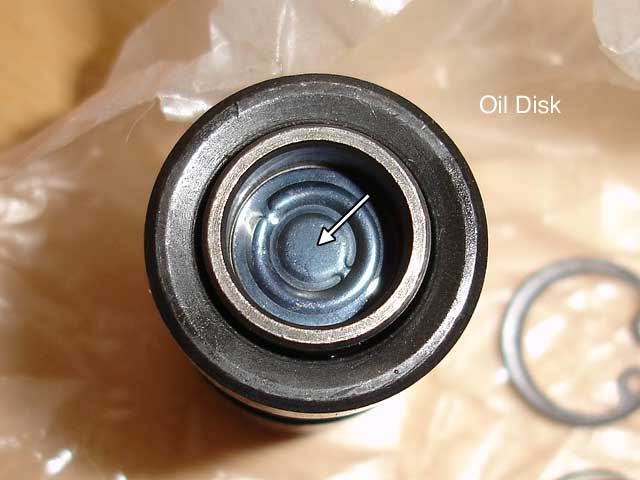
| Underneath the socket is an oil metering disc that bleeds oil from the plunger body thru the hole in the socket, down the push rod to the rocker arms. | Lifters are shipped with a protective coating of light machine oil only. You MUST fill them with engine oil prior to installation. |

|
|
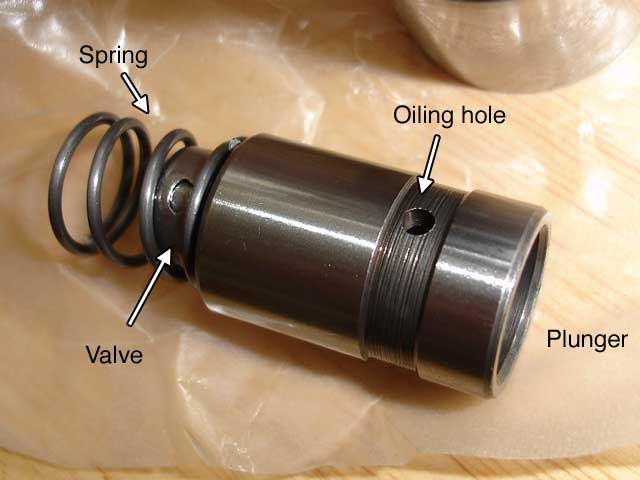
| The plunger is a precision fit against the lifter body. | The plunger is supported at the base by a spring and has an oiling hole in its side. |

|

|
| The plunger is hollow. Oil builds up in the cavity and is fed to the push rod tubes. | The plunger spring is in compression when the lifter is assembled. When compressed, it can only move 4mm at which point the lifter will bottom out. |

|

|
| The lifter body has an oil passage on its side to pick up oil from the lifter bore in the case. The plunger rotates inside the lifter body just as the body rotates within the lifter bore in the case. | The hole in the body may partially line up with the hole in the plunger as it rotates but only when the plunger is uncompressed. |

The engineering behind them is quite sophisticated but how they work is easy to understand. Think about the tolerances we are working with as a starting point.
We know that the engine expansion rate depends on operating temperature. At normal operating temperature, the valve clearance has changed from the initial gap of 0.006" on a solid lifter engine to a smaller one. We know there is still a gap because we can hear it. How much gap and by what temperature only the VW engineers really knew. That gap is set to accommodate the ideal expansion and since the engine isn't at the ideal expansion at all time, the adjustment is imperfect especially at startup. The hydraulic valve train is designed to eliminate the gap at all engine temperatures: a more efficient design.
Instead of setting the valve lash to 0.006", the hydraulic adjusting screw makes contact with the valve stem and you turn the screw a couple turns and you're finished. No feeler gauges are required. The engine pumps the lifter full of oil and as the clearances of the engine parts change due to heating expansion, the lifter adjusts automatically. Besides fewer required valve adjustments it means less startup wear on the valve train compared to a solid lifter engine because the engine is adjusted at all temperatures not just when the engine is hot.
The lifter has four main components: the body, socket, plunger and valve mechanism. The body moves with the cam and the plunger/socket moves with the push rod. Riding between the two is the weak plunger spring and a cushion of oil. All of the cavities within the lifter are filled with engine oil.
Note: lifters lie on their sides in a boxer engine configuration like the Type 4 engine.
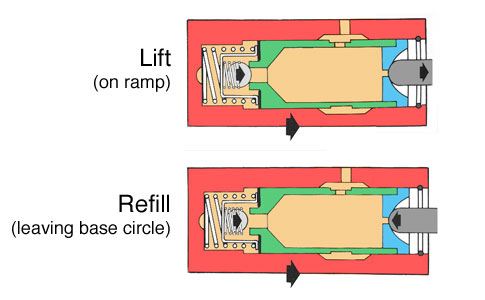
The lifter gets pressurized by the oil gallery feeding the lifter bore only during the start of motion. The oil pressure is just enough fully engage the valve train but not enough to overcome the stiff valve spring and open the valve in the head: that's the job of the cam pushing on the lifter body.
There is a small valve in each lifter and the one illustrated is a check-ball design. The check-ball is held in place by a tiny spring and the motion of the lifter opens the check-ball cavity because inertia leaves the check ball behind but only for a brief moment.
Compared to a sold lifter camshaft, the base circle of the hydraulic cam has been reduced to allow the extra time required to fully pressurize the lifter.
When the cam pushes the lifter body forward, the plunger is held in place by the tension from the push rod and the valve cavity decreases in size slightly. The check-ball inside the valve is held in place by its support spring and pressure from the oil in the cavity forces the check ball forward which closes off the valve opening to the valve cavity. This traps incompressible oil in the valve cavity, causing the plunger assembly to move with the lifter body which moves the push rod and opens the valve in the head. After this point the lifter effectively becomes a solid lifter.
As the cam completes its rotation and the valve spring forces the lifter body to return to its original rest position on the base circle of the cam, the check-ball is no longer under as much pressure and is ready to be pushed into its support spring by the gallery oil pressure. The oil pressure within the lifter cavities equalize as new oil is forced throughout.
The light pressure of the plunger spring in the check-ball cavity keeps all of the components in the valve train in gentle contact but does not have enough pressure to keep the valve in the head from closing. At the end of the cycle, the force from the push rod pushes out a small quantity of oil from the lifter at the end of its travel which creates a cushioning effect. The lash of the solid lifter valve train has been moved inside the lifter of the hydraulic valve-train where the components can be gently cushioned by the oil.
As with a solid lifter push rod, oil is circulated through the lifter and through the center of the hydraulic push rod tube to lubricate the rocker arms. The oil galleries feed the push rod tubes and while this oil passes through the lifter the amount of oil (which varies with engine rpm) does not affect the amount of oil that escapes from the check-ball cavity (up to a limit we can't reach with a stock engine). The end result is a very quiet valve train compared to a solid lifter engine. Expansion of metal parts in the valve train is compensated for by automatically adjusting the distance between the base of the plunger and the seat in the bottom of the lifter body (the volume of oil in the check-ball cavity). How the lifter pressurizes while circulating the oil is the genius of the design.
The plunger can move a maximum of 4mm in the bore but it would bottom out if it did. In order to keep the spring of the plunger in contact with the lifter body, the spring is compressed just enough (about 1.5mm) during manual valve adjustment to center the base of the plunger relative to the bottom of the lifter. When the engine is running, the exact amount of adjustment varies with the expansion of the engine. Remember that the design of the lifter is only trying to eliminate a few thousands of an inch of clearance but it must be compressed 15x that in order to prime the valve inside.
The operation of the hydraulic lifter is very complicated component despite its size and the construction of the lifter has the tightest manufacturing tolerances of any part in the engine. It's a precision part that is designed to self-adjust based on oil pressures and spring tensions calculated by the VW engineers.
So how can you tell that you've got them? There is no guaranteed way to know unless you examine the lifters themselves (even if you happen to be the original owner because mechanics can do evil things to engines to get them out of the shop).
Here are some clues to look for in order to help you determine if you have hydraulic lifters:
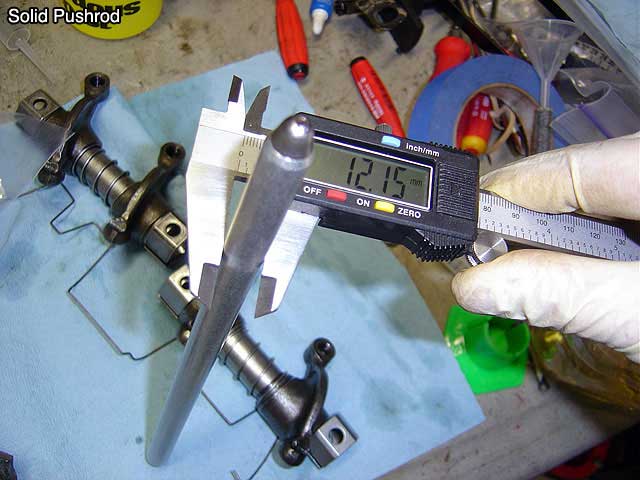
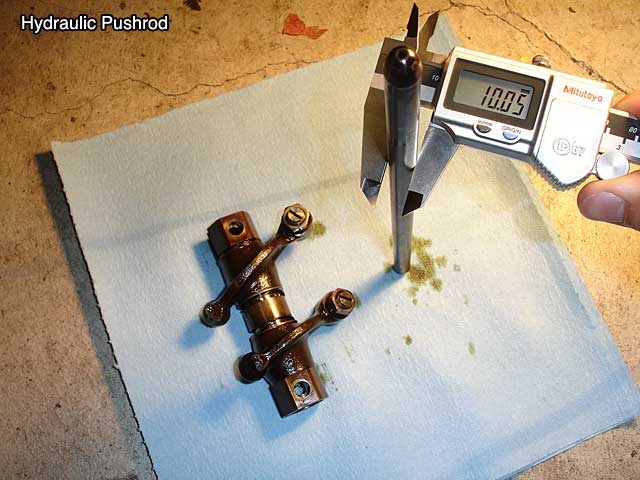
If a magnet sticks to the push rod shaft you've got hydraulic (steel) push rods. If it only sticks to the tips, you've got solid (aluminum) push rods.

|
|
| Solid: Aluminum with steel tips (271mm long) | Solid: 12mm ø |

|
|
| Hydraulic: 1-piece steel (262mm long) | Hydraulic: 10mm ø |
Even after verifying all the above, you can still have a solid lifter in your engine thanks to the PO and the fact that parts like the fan shroud can be easily swapped around. You may have a 78-79 bus with solid lifters or even a 72-77 bus with hydraulics because engine replacement is also common with these old vehicles. Assuming you have hydraulics when you have solids will cause you a lot of grief down the road that would have been avoided by a brief post-purchase inspection.
If you have issues, it's often the case that a) you bought the bus, assumed it was ok and drove it until the lifters started to make noises or b) adjusted them like solids and can't stand the noise they make.
Fortunately, unlike the Type 1 engine, the lifters can be removed from the Type 4 engine without splitting the case. If you can change push rod tube seals, you can remove a lifter to inspect it.
All you need to do is breakdown the valve train (5 min), remove the push rod tubes (15 min) and pull out the lifters with a magnet (2 min). It's very important not to mix lifters and bores so either remove one at a time or label them so you don't mix them up. This is because each lifter wears against the cam lobe which wears against the lifter on the other side. If you are thinking you can swap them left to right, you probably can but I don't see any benefit to doing so. The underside of the engine is a dirty place so keep the lifter 100% clean of debris and also clean the area near the bore before attempting to re-insert the lifter.
If the lifter has an oiling hole in the side, a wide waist and a lock ring on the end, it's almost assuredly a hydraulic lifter but the only way to be 100% sure it to take it apart. Because after-market lifters look a little different than the factory solid lifters, identification can sometimes also be difficult.
A not so well known observation is that for best results, engines with hydraulic lifters require period adjustment just like other engines do.
Unfortunately the idea that no adjustment is required was perpetuated by VW:
Perhaps the requirement for adjustment (although less frequent than a solid lifter) is a weakness in the design or the fact that the owner didn't follow the oil change guidelines and the lifters suffered as a result. Some people have owned their buses for 20 years, never adjusted the valves and had no issues! If only we could all be so lucky but there is a reason behind their success...
When hydraulic lifters stop working correctly, they need to be re-adjusted. Expecting them to eventually pump up and become quiet again is unrealistic. Sometimes all it takes is an oil change which is great news because it's not an obvious solution to typical engine problems other than low oil pressure. Your luck with hydraulic lifters will depend on the various PO abuses: in-frequent oil changes, low oil level, etc.
What's key about hydraulic lifters is that they are self-adjusting AFTER they have been set properly. If not correctly adjusted you will either a) break the plunger inside the lifter b) pound a valve seat c) burn a valve that's left open by the lifter, etc. How long this will take is not predictable.
It is prudent is to adjust the valves upon purchase of a vehicle regardless of whether or not you are told the engine has hydraulic lifters. The reason is simply because you have no idea what prior skill was used to maintain the engine nor the assurance that the engine contains the expected parts. Most owners have not used the dealership for tune-ups for decades and only a handful of dealerships fix these vehicles anymore (at dealer prices btw). Your average VW monkey with no dealership training knows about as much about these late baywindow buses as he does about curing cancer. Many owners when they first start to examine their engines in detail for themselves are often shocked to find differences that were not advertised or known by the PO.
Bentley (both Bus and Vanagon versions) say the adjustment should be two clockwise turns after the valve adjusting screw makes contact with the valve stem but some folks think the adjustment should be 1/2 turn. If the lifter was dry and you were to preload the lifter 1/2 turn, that's about 0.015" (0.38mm) movement of the piston inside while 1-2 turns would be 0.030" - 0.060" (0.76mm - 1.52mm). I will explain how much to adjust the lifters later...
If you only adjust them by 0.5 turns the lifter won't compress enough and you'll upset the rocker geometry accelerating valve train wear. In practice what happens when you don't preload the lifter enough is it will take too much time to pressurize and you won't get enough valve lift. This will cause the engine to labor and sound noisy. The noise is often heard coming from the camshaft (center of the engine).
Two turns of the 10mm valve adjusting screw with 1mm threads will preload the lifter ~1.5mm (remember the 1:1.3 rocker ratio). This is about half the distance that the piston inside the lifter can travel. If you use too little preload you will stress the lock ring that holds the lifter together when the lifter socket maks contact with it. If you use too much preload, the plunger may bottom out at first, then as the lifter pumps up to compensate the valve may not close properly and compression, performance and valve life will suffer.
How about 1.5 turns instead of 2? In practice, this seems to be as acceptable as the factory recommendation and a feel good insurance against the ills that other people have experienced over the years following the factory recommendation. In my experience, 1.5 turns of adjustment after the engine has run for many miles remains around 1.5 turns. Sometimes the adjustment is 1/8 of a turn more or less but you will be in the ball park and the engine will continue to run properly thanks to the flexibility of the design. The fact that the setting can exceed the initial adjustment supports the idea that 1.5 turns is better than 2.0 turns.
When I first learned to adjust hydraulic lifter I used the following advice before following the steps in Bentley:
It wasn't the most convenient technique but it worked ok. Over time through research and experimentation, I realized that it's best to adjust them with the engine warm (VW even says that a solid lifter engine can be adjusted up to an oil temperature of 50ºC/122ºF).
The steps I prefer to follow are:
Perform a valve adjustment sequence. For each valve...
What this does is a) make me aware of the current state of adjustment b) check that the valves are sealing c) verify the dynamic compression will allow the engine to run correctly. When the last two conditions are true, you can attribute running problems to fuel delivery, ignition or mixture unless you hear an obvious noise coming from the lifters.
It's very important to do a complete tune-up because idle rpm adjustments can somewhat compensate for a poorly running engine. To be 100% thorough, don't forget to check the air fuel ratio. If you skip the last step you can put yourself in a position of wondering why on earth the engine runs worse than before you adjusted your valves when you didn't adjust anything else. This is not a hydraulic issue: you are having to reset the AFR from point of compensation to the correct setting for a tuned engine.
Keep in mind that after an oil change and adjustment it can take 10 mins for the lifters to re-adjust completely. This is because oil related problems are not instantly cured by an oil change due to the fact that you cannot remove all of the oil from the engine. Contaminated oil will take some time to recirculate and dilute in the new oil.
Remember that when turning the adjusting screw on the engine you are working against the valve spring if the lifter is full of oil. You can test this by pressing on the knurled base of the rocker arm with a screwdriver. If there is any movement, then the lifter is soft and your adjustment will be compressing the spring inside the lifter instead of moving the valve spring (normal). If this happens, you should run the engine with a 0.006" (0.15mm) clearance on that lifter for 10-15 minutes then re-attempt a hydraulic adjustment when the hot valve cover cools enough for you to touch it again. This advice comes from direct from the late Boston Bob (see references).
VW set specific guidelines for oil changes:
All sources are in agreement: good.
Oil is the life blood of the engine and clean "healthy" oil is important for the hydraulic lifters to operate properly. VW didn't make up these guidelines to get you into the dealer more often. Oil is a consumable item and its longevity depends on many factors. Use dirty oil and the lifters may score like a bearing. Use oil contaminated with blow-by and moisture from short trips and cold weather driving and they will eventually act up. Gasoline leaking into the crankcase is equally bad (it's a lousy lubricant compared to oil).
Despite anti-foaming agents in oil, if the level drops sufficiently it will aerate in the pump and cause lifter issues. This means if your oil is below the lower mark on the dipstick you may hear clattering of the lifters unnecessarily so keep the crankcase oil level at or near the top mark at all times. Hot thin oil lets the lifter bleed down quickly which you may witness when you restart the engine after a long highway run. Eventually oil breaks down and loses its viscosity which leads to similar issues as hot thin oil.
Cleaning the strainer is very important. If you don't think there is any sludge in your oil, just check the bottom of the strainer. When you break in a new engine you will find bearing material and case sealant there. When the oil thickens after it has long expired, it ends up in the strainer first. When there is moisture in the crankcase, a white milky oil collects in the strainer. Just because the engine has a full flow oil filter is no excuse to ignore the guidelines. Cleaning the strainer is part of the engine maintenance schedule.
The data in the owner's manual and Bentley is out of date according to many. These cars have been out of production for decades and changes to the guidelines ceased long ago.
When to ignore the manual: you do not need to switch to SAE40 (or even SAE50) if the outside temperature exceeds 25ºC (77ºF). Those oil grades are too thick for the engine when the mornings are cold so I would only use a multi-grade oil (that is why they exist). It would have been far more useful if VW had published an oil temperature guideline but for some reason VW chose not to install engine monitoring gauges into a vehicle. This made sense in 1943 when they were shaving pennies from the production costs to see if they couldn't build an affordable people's car but not in 1978 even though cost increases due to inflation existed.
The VWoA recommendations for 1977 models are even more confusing because depending on where you live it can be 60ºF in the morning and 90ºF by 1pm. Ignore that dated advice.
I've always used 10w40, 15w40, 15w50 and 20w50 in my engine. The smaller the gap between the two numbers the better (or so the oil experts say). When I lived in Canada on the west coast, I preferred 10w40. When I was living in Texas I used 15w40 and 20w50. Now that I'm in California in the Bay Area I find 15w40 or 15w50 suitable depending on the time of year.
Perhaps unexpected, the actual state of the engine determines what oil is necessary. VW says that you should see 42 psi with SAE30 oil at 175ºF when the engine rpm is 2500; the wear limit is 28 psi. As the bearings wear, the clearances increase and this causes the oil pressure to drop.
What makes this test awkward is that multi-grade engine oil viscosities are rated at 0ºC (32ºF) and 100ºC (212ºF). What this means is that the viscosity of SAE30 will be higher than 10w30 at 175ºF until 212ºF is reached when 10w30 behaves like a 30 weight oil. This makes it difficult to determine if your multi-grade oil is meeting the standard set by VW. Assuming that there is only a small oil pressure drop with an increase of 21ºC (37ºF) I would take the pressure measurement at test temp and rpm to decide what oil to use.
During startup, 175ºF is reached fairly quickly when it's 75ºF outside, so you should let the engine idle in the driveway while you watch your gauges. Since, the oil pressure increases with the engine speed and decreases with increasing temperature, the exact pressure is hard to predict especially since the intake air temperature, affecting the oil cooler, drops while driving. The test suggests that if you can't achieve that minimum oil pressure at the test speed and temperature, switch to the next successively thicker oil. I've never heard of a working engine that couldn't build sufficient oil pressure with SAE50 but I suppose it's possible.
If the oil warning light flickers while driving on the highway, it's another indication that your oil is too thin.
One day I will break in a new engine and using each grade of oil, graph the various oil pressures at normal operating temperature to witness the effect. If you beat me to it, send me the results.
The advantage of solid lifters over hydraulics is that the condition of the valves is easily inspected. This is the main philosophical reason why folks prefer them (especially engine builders because hydraulics compound warranty issues). Because cylinder heads don't last forever, it means that a hydraulic valve train also requires an inspection now and again even though they might not require an adjustment.
Car owners don't like change, especially VW owners and I've read a lot of excuses about hydraulics but the only one that's really of concern is that periodic solid lifter adjustments helps you to notice a dropping valve seat or stretching valve because you are examining the valves and you will notice a shrinking gap. Type 4 heads fail for one reason: folks think they are ok and drive them hard when they are not ok and a valve problem develops. No matter what kind of lifters you have, you should remove the valve covers periodically to inspect the heads. Adjustment is so easy with hydraulics there is no excuse.
Think about this advantage of solid lifters: the fact that you can watch the valves go tight. With a solid lifter valve train, once a valve starts to stretch or the seat starts to drop there usually is no stopping it. Further valve adjustment will just accelerate the problem so you have no choice but to repair the head asap. With hydraulic lifters small changes like this are absorbed by the valve train. In theory it will keep the head going for longer but at some point the valve has to break and since you don't know when it will happen you need some other indicator of wear. Valves suffer the exact same failures in both types of engines.
Hydraulic owners aren't totally in the dark with regard to dropping valve seats: you could measure the distance of the spring retainer to the head using a depth measuring tool. It's not as easy to do as using a feeler gauge but still possible. Measuring a stretching valve can't be checked by counting rotations of the adjusting screw until clearance because the state of the lifter is an unknown. The best you can do is, remove the rocker arms and using a precision flat bar that a machinist would use, see which valve stems are not at the same height (it's highly unlikely that all the valves are stretching at the same rate).
Even with the solid lifter engine, wear at the cam/lifter can make up for a shrinking clearance at the valve stem which will go unnoticed.
If you really care about cylinder head condition, perform a leak down test to verify your valves are in good shape. It's the only way to be sure and you'll be able to tell if any of the valves aren't seating properly before the need to remove the valve covers to inspect further. If the valves have stretched from overheating, chances are that the valve seat has also deformed which the leak-down will indicate. You can even do the test when the engine is still warm to see if a valve isn't seating.
Although it seems like a good idea, you CANNOT use a leak-down gauge to adjust the valves because when the lifters are hydro-locked you will simply be moving the valve because the valve spring will move first. If you try to adjust an open valve by closing it until the leak-down gauge reads best, the lifter will not pump up properly just as if you adjusted them to zero lash or 1/2 turn.
Only when the lifter is partially full of oil will the valve spring overcome the lifter spring so how can you set the adjustment precisely? The key is that dynamic motion of the lifters is what pumps them up properly so the valve adjustment is simply a static process you have to follow and trust that the engineering is working correctly.
The real beef against using hydraulics is that the engineering is not flawless and when you let the engine sit the lifters can sometimes bleed down and become air-bound. Lifters that bleed down regularly indicate wear or old oil. What is observed? A normally quiet valve train has now been replaced by one that is much louder than one on a solid lifter engine. It's for this reason, that people decide to stick with the solid lifter design even though it means more valve adjustments.
When adjusted properly the valve train sounds like this:
The slight variation (pulsing) in the sound it due to the unevenness of the ignition system at the time of capturing the audio.
Now compare that smooth sound to what happens when the lifter bleeds down:
Booda-booda-booda is what you'll hear. These sounds were recorded near the air intakes just as your ear would hear them. Notice that the engine is idling poorly. This is because it can't breath properly (the valves are closing too early).
Anytime the engine is stopped, one or more lifters will be under pressure from the camshaft and the valve spring. The noise occurs because the lifters which are normally refreshed with oil as they rotate in their bores, will eventually let the oil out through the oiling hole and introduce air which is compressible.
If you start the engine every day you should never hear the ticking sound of an air-bound lifer. If you let it sit for a week then you might hear it for 5-10 seconds before it goes away but not before you watch the oil light flicker from on to off. If you let the engine sit for 4 years, as I did once, you might hear the ticking lifters sound for 30 minutes or longer.
The solution to this problem couldn't be easier: drive your bus regularly and don't let it sit!
Unfortunately for those of us buying used buses we have to contend with noisy lifters and all of their issues due to the PO neglecting it or letting it sit in the driveway for several years without firing up the engine.
How long should you wait before deciding the lifters won't pump up on their own? I'd say 35 minutes. After that you'll have to remove the lifters from their bores with a magnet and clean/bleed them the bench using the instructions in the Vanagon Bentley. Be sure to clean them throughly with carb cleaner to remove any build up varnish. It's the inevitable varnish built-up that causes problems down the road.
Adding ATF, Rislone often helps to pump up habitually stuck lifers without removal by dissolving the varnish but be careful because these products are not engine oil and therefore they do not lubricate like engine oil so just use them briefly then flush them from the engine. Some people swear by Marvel Mystery Oil but I've never used anything in an engine other than a temporary use of Rislone.
Some folks use a thicker oil to attempt to raise the pressure in the galleries. Some think thinner oil is a better idea hoping it gets into the lifters easier. The mere act of changing the contaminated oil is what's having the greatest impact on fixing the noise issue. Because of the tight clearances and the inability to drain the engine completely of oil, it may take two successive oil changes to get the lifters clean again.
Bench bleeding is not required to maintain the lifters as it's often a one time fix to correct a history of abuse. All you need to do is run the engine AND change your oil regularly according to the maintenance schedule. If you don't drive your bus often, hydraulic lifters probably aren't for you.
Why does the lifter bleed down at all? I had originally believed as was commonly proffered that since lifters lie on their side that the oiling hole could be facing downward at the time the engine stopped. If this was the reason, then it would be possible for all lifters to bleed down at the same time since they rotate in their bores and I've never heard of this happening.
Some lifters will be under residual pressure from the camshaft depending on the positions of the camshaft lobes when the engine stopped but I've come to suspect that hydraulic lifters bleed down when they are subjected to minimum force from the cam lobe and the push rod.
There is a position when the lifter is able to accept oil from the gallery and re-pressurize itself and this position probably is where bleed down can occur. If lifters were 100% sealed they would be solid lifters. A hydraulic lifter refills with oil via a reciprocating motion.
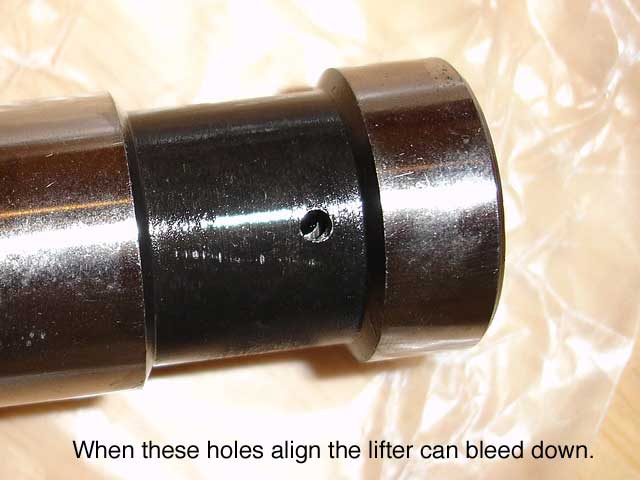
When properly pre-loaded, the oiling hole in the plunger is partially aligned with the oiling hole in the body but these facts don't completely explain why some lifters bleed down while others do not. In my experience it always seem to be the same lifters give you trouble by bleeding down and pumping up regularly from the engine sitting for long periods.
I would like to know if particular lifters are more prone to bleed down than others but I don't have enough evidence to draw any conclusions.
|
|
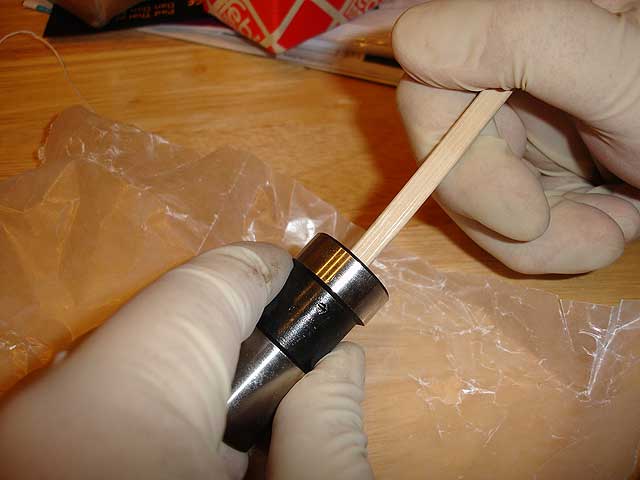
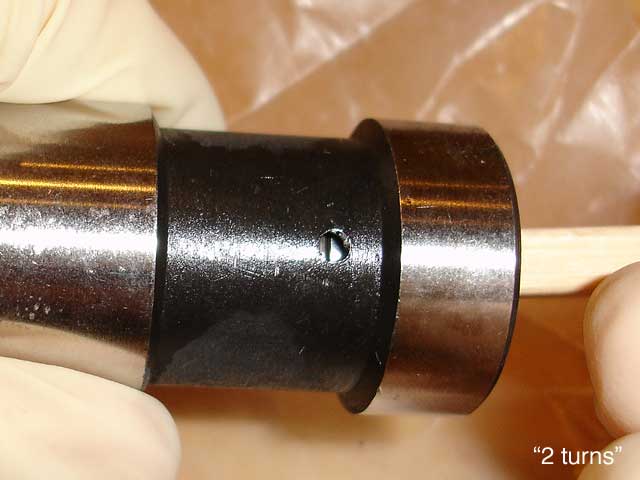
| It's difficult to visualize what's happening during adjustment when you simply read Bentley. | Apply some pressure to the plunger with a chopstick or push rod. Do not accidentally contaminate the lifter. |
|
|
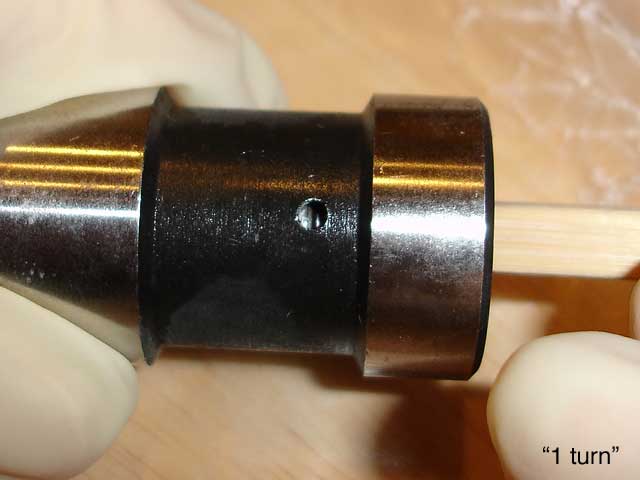
| Notice how the shoulder on the plunger is beginning to obscure the outer oiling hole. | After full adjustment the shoulder is closing the hole 1/2 way. |
Detractors make these claims about hydraulic lifter engines:
They've seen more broken engine cores with hydraulic lifters: you simply can't tell what the PO did to the engine that made the engine blow. When the valve hits the piston, the resulting force can break a solid lifter so finding a broken hydraulic lifter is no evidence that they caused the engine to fail. From an empirical point of view, the logic is flawed. For every rebuilder that's torn down an engine with a broken lifter there is a driver out there with 125,000 mi. on his hydraulic lifters.
Some VW employee told them they were added to improve sagging sales: this is pure here-say. Was it a marketing gimmick to compete with other watercooled makes that had to adjust their valves or improved/fad engineering? Doubtful. English speaking VW owners may never know but what we know for sure is that the technology was new and promising at the time.
They are power robbing: true if you consider there are rpm limits to them but this is not important for stock engines with stock rev limits and this issue isn't limited to VWs.
They wear out the cams faster: this does not explain the fact that people have achieved 248,000 miles with their factory hydraulic cam.
They make the cam flat: the travel of the plunger inside the lifter is limited to ~4mm (0.157"). If the lift of the cam is 0.233" what causes the cam to go flat? The mechanic making endless adjustments...
They are noisy: when incorrectly adjusted and not maintained properly this is certainly true.
Many manufacturers use hydraulic lifters in their engines and VW was probably attracted to this system to help deal with the ever difficult engine maintenance access imposed by altered sedan and bus body styles. Longer engine life and reduced maintenance were also desirable marketing points especially in the late seventies when the days of the aircooled engine were numbered and VW was desperately clinging onto the design. However, VW itself was switching to watercooled Audi-based engine designs, mostly front mounted so the less maintenance argument would seem to draw attention to other models in the product line more than competing makes. VW's aircooled design has always been the odd one out but it never stopped them for selling millions.
Hydraulic lifters are a potential solution to a body design problem. Certainly, no VW owner wants to pay Porsche mechanic tune-up prices caused by unusually difficult engine access but I don't buy the marketing argument above because all body styles to end up with them have unobstructed valve covers. There was little reason to switch at that point unless VW considered the engineering to be a sound improvement.
Sometimes performance is cited as the reason they weren't used in the 1969-1974 VW 411/412, 1970-76 Porsche 914 and 1976 Porsche 912E which used solid lifters just like the 1972-76 Baywindow Bus. All shared the Type 4 engine design and the reason they used solid lifters rather than hydraulic has more to do with introduction date than performance. All those models were discontinued before 1978.
Other times, emissions is cited as the reason. Volkswagen engineers were no dummies but sometimes they did have to modify engine designs to meet stricter emission standards and run in a variety of climates. Porsche engineers had to make the same compromises. These choices are often picked apart by a few people who have modified their engines into an illegal configuration and the argument quickly degenerates into an apples vs. oranges debate. This doesn't make these people smarter than the VW engineers, only aware of certain design limitations. When you are interested in maintaining stock engines, their advice, although often well intended is often misplaced.
Since hydraulic lifters have little to do with performance and ever less with emissions, debate about them is simply a matter of whether or not they work as intended. Hydraulic lifters are clearly dual purpose since they aren't limited to rear engine or even aircooled designs and few people can explain why they were introduced by VW into the beetle engine that went 40 years without them. It's no wonder so much mystery surrounds them.
The advantages of the design are:
In his book, Tom Wilson says about hydraulic lifters:
He wrote, "Any mechanical-lifter is a compromise. The adjustment must be tight enough to take maximum advantage of the cam profile, but loose enough to provide clearance when the engine is hot and swollen like a balloon. That means the mechanical-lifter valve adjustment is at its optimum at only one engine temperature. The hydraulic lifters stay at optimum from the second they fill with oil at engine start-up to engine shut-off. They keep the valves perfectly adjusted in Arctic winter or Sahara summer".
Before you begin to think I'm waxing on about how perfect they are (they aren't), the practical disadvantage to them is inheriting an abused bus which can give you fits trying to achieve smooth and quiet operation. For the very same reason replacing the fuel injection with carbs is stupid idea because your mechanic doesn't understand how the double relay is wired, replacing hydraulic lifters with solids to cure the noisy operation is equally ill-advised. These are classic cases of fixing symptoms instead of problems.
One time my lifters (most of them) bled down after 4 years of non-use. They all stopped clattering after 15-30 minutes with fresh oil and no valve adjustment. The time before that they bled down after 7 years of sitting with a little Rislone. See a pattern? I think oil varnish maybe the culprit.
With all that unholy tapping sound during those two hard starts, the factory hydraulic lifters are still in my engine going strong. These are not weak parts as some would have you believe.
When they start making noise, it's time to change your oil and no bus should be brought out of hibernation using oil that has been sitting in the crankcase for several years.
Some argue that the cylinder heads on hydraulic lifter engines suffer more. Well, 72-77 busses have plenty of head problems without hydraulic lifters and there still seem to be a lot of 78/79 buses and Vanagons on the road with their original engines. Time to find a more meaningful debate don't you think?
Here's what Webcam says on the subject (tappet and follower are synonymous with lifter):
"The single most important factor for successful operation of any hydraulic tappet is cleanliness. The assemblies are highly precision units manufactured with clearances between mating parts that may be no more than 0.0002". The plungers and bodies are not interchangeable".
In other words, this is the most precision part in the engine. The "2/10ths" figure shown above is about 5 microns. The average oil filter cannot filter 100% of particles that small. Wow!
More on the subject for Webcam:
"Since the hydraulic tappet in operation is entirely dependent on the condition of the engine oil, frequent and regular changes of the oil and oil filter, as recommended by the manufacturer are an absolute necessity. And dirt, sludge, metal particles, or other foreign bodies can cause damage to the tappets".
There you have it: change your oil and filter frequently (and clean your strainer) and keep the oil level topped up. I've always done this and I've had happy results. Hopefully you will too and we'll pass each other on the road one day...
A lot of VW advice is dispensed by folks who are just repeating what they've heard or read online. If you feel you must take their advice and remove the hydraulic lifters from your engine because you've been told it will blow up, you will need to replace the following items:
push rods - different material and length
valve springs - stiffer
More important is the fact that hydraulic cases don't have the 2nd oil control valve like all other dual relief cases have and you'll be trying to out engineer VW with your modifications.
Opinions are divided on hydraulics so the choice to use them probably comes down to this: you either have them or you don't. When they work as advertised it's a lot less maintenance work for you. When they give you trouble, it's a lot more trouble than any solid lifter will give you. It's for this reason that some people prefer solid lifters on stock 72-79 Type 4 engines. Weighing the pros and cons it often makes the most sense to simply stick with what you have.
In my experience, I simply drive the bus often and change the oil according the the schedule VW laid out (do not rely on mileage alone trying to save a few dollars). That's all!
07/08/05 - Moved from FAQ
08/05/05 - Added photos
09/30/05 - Added my exploded diagrams
04/08/07 - Added push rod photos
09/07/11 - Fixed broken photos, added translate button, updated footer
07/15/19 - Google update: new adsense code, removed defunt translate button
09/22/20 - Added engine code and VIN cutoffs
12/13/20 - Fixed audio clips
